· Tim Kleier with Claude (Anthropic) · Engineering · 4 min read
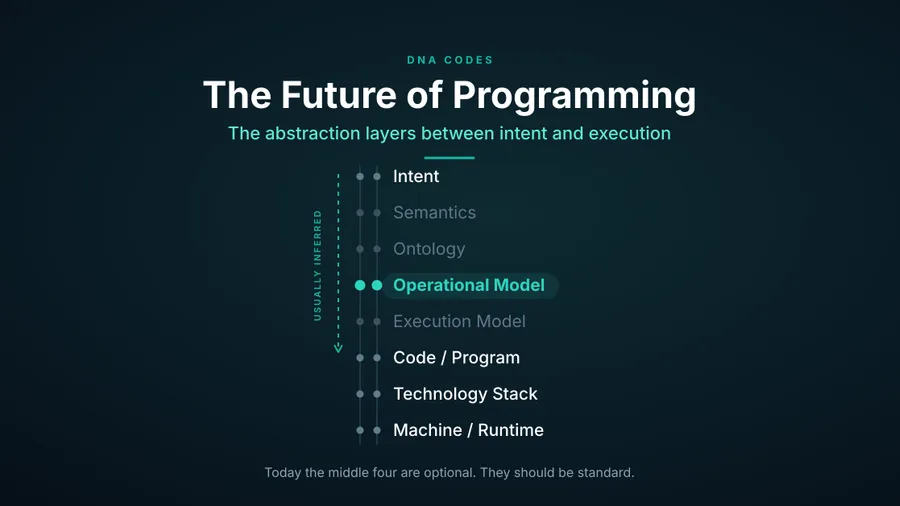
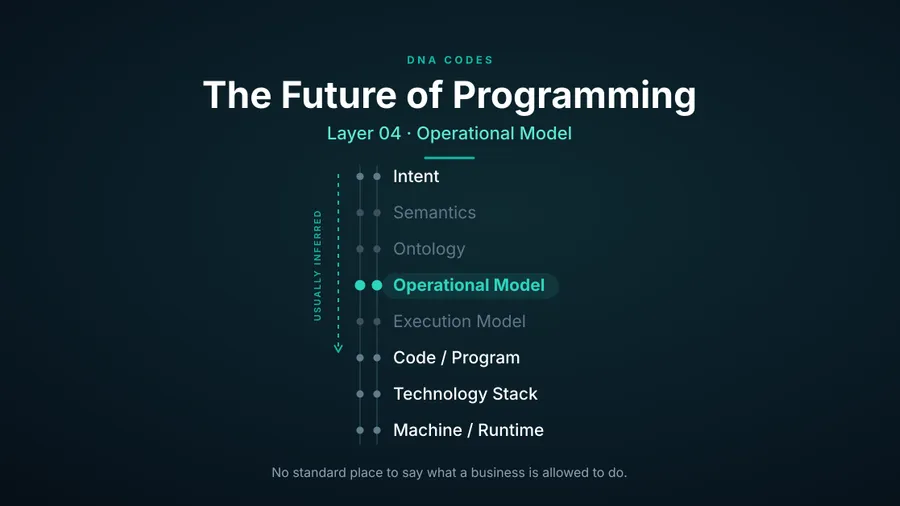
The Future of Programming · Layer 04: Operational Model
The Operational Model: Formally Capturing Business Operations
Biz Ops is often a function and/or team in organizations that captures the key processes of a company. The operational model formalizes business operations, and puts it in context: after the ontology, and before execution.
Ask someone about a key business process. How an invoice gets paid. How a claim gets settled. What comes back is hand-waving, an hour-long tour, or “I will get back to you on that.”
A Biz Ops function often already has the pieces: an SOP, a process map, notes from a workshop. Engineering has the code. There is no map between them. The docs describe the process but the code could be running an older or incorrect version of it. That’s why the answer is often unclear.
The Operational Layer
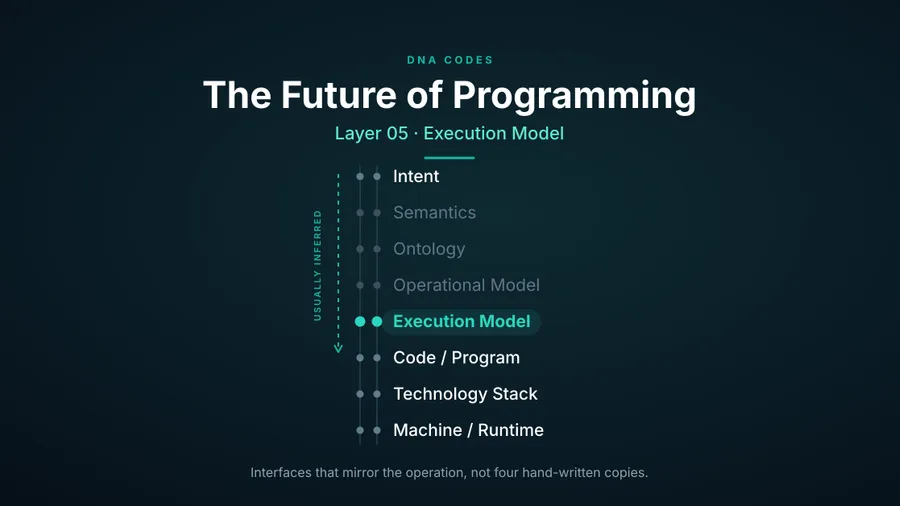
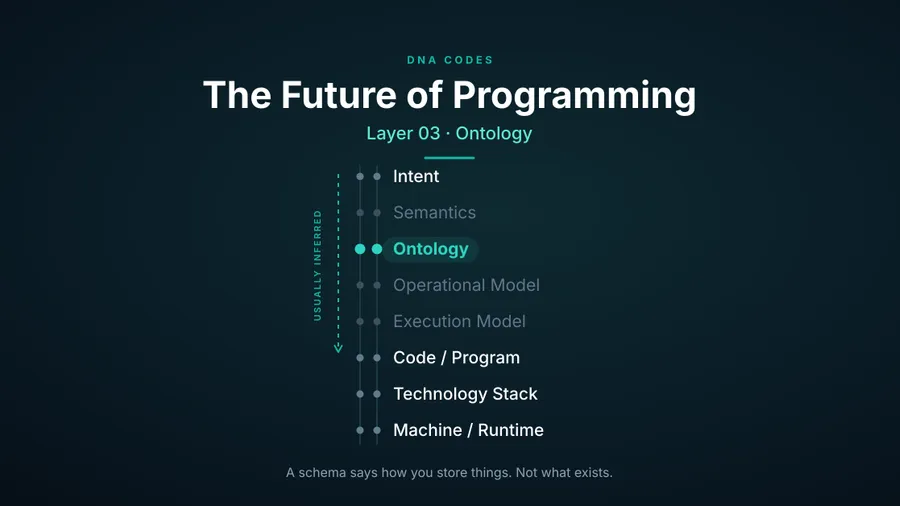
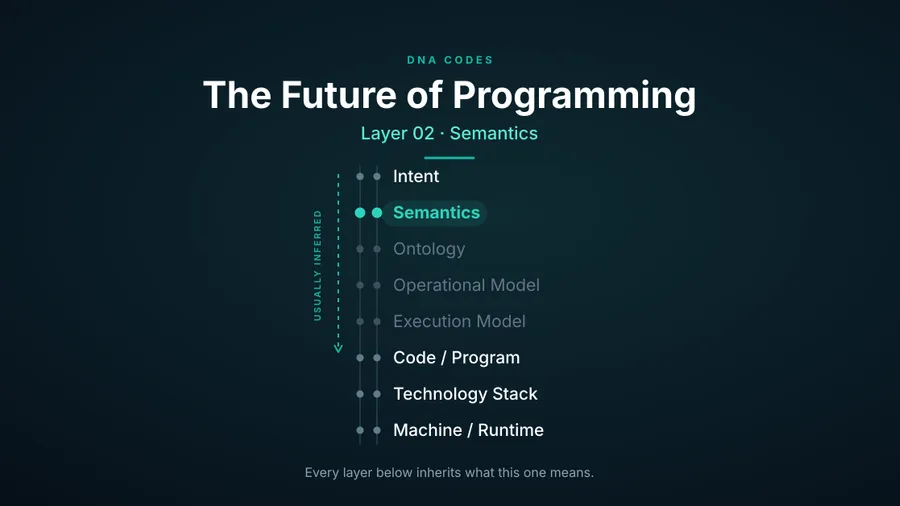
To get this clarity, we need a formal layer to map between Operations and their execution. That layer is behavior, the formal version of what Biz Ops already catalogues: what happens, to what, with what inputs and outputs. Ontology defines the structure an operation is written against. Operations says what happens to that structure. Execution is the layer below: its construct is the Interface, a button, an endpoint, and an agent tool that run an operation rather than defining one. This is the last layer that is still about the business.
Actor, Action, Resource
The primitive is an Operation. At its base it is a triple: Actor → Action → Resource. Subject, verb, object. That is the atomic sentence of Biz Ops, and it has the same shape in a hospital, a lender, and a warehouse.
An actor is who performs the action. A person, a system, or an AI agent. The physician discharging an encounter, the billing system issuing an invoice, the collections agent escalating one. The actor belongs on the operation because the work has a performer. A verb with nobody doing it is not yet an operation.
An action is a verb on a noun, and it has a lifecycle. Underneath, it is a function against the ontology: it reads and writes domains, entities, attributes, and relationships. A verb that cannot say which noun it touches is a label, not an action.
A resource is anything operable. That includes the ontology itself: any domain, entity, attribute, or relationship. It also includes the rest of what a business handles: a file, a signed contract, a generated report. If the work touches it, it is a resource.
The triple is the base, not the whole operation. An operation also has inputs and outputs, as well as potential conditions.
The grid below keeps inputs and outputs off. Those vary by operation. The triple and its condition do not.
| Industry | Actor | Action | Resource | Condition |
|---|---|---|---|---|
| Lending | UnderwriterPerson | Approve | LoanApplication | Credit policy passes and collateral is valued |
| Care | PhysicianPerson | Discharge | Encounter | Required orders have resulted |
| Logistics | DispatcherPerson | Dispatch | Shipment | A carrier is assigned and the window is open |
| Billing | Billing systemSystem | Issue | Invoice | The order is fulfilled |
| Collections | Collections agentAgent | Escalate | Invoice | Past due, and no payment recorded |
| Compliance | Records officerPerson | Archive | SignedContract | The file is fully executed |
Lending · Person
Underwriter → Approve → LoanApplication
Credit policy passes and collateral is valued
Care · Person
Physician → Discharge → Encounter
Required orders have resulted
Logistics · Person
Dispatcher → Dispatch → Shipment
A carrier is assigned and the window is open
Billing · System
Billing system → Issue → Invoice
The order is fulfilled
Collections · Agent
Collections agent → Escalate → Invoice
Past due, and no payment recorded
Compliance · Person
Records officer → Archive → SignedContract
The file is fully executed
Workflows
One operation is a sentence. A process is the paragraph.
A workflow composes operations into paths. Some run in sequence, some in parallel, some branch. That is the SOP, the process map, the Event Storming board a Biz Ops team already keeps. Each step names an actor, an action, and a resource.
1Person · Sales lead
AcceptOrder
Quote is approved
In parallel
2aSystem · Warehouse system
ReserveInventory
Stock is on hand
2bSystem · Payments system
AuthorizePayment
Funds are available
3System · Carrier
ShipShipment
Stock reserved and payment authorized
4System · Billing system
IssueInvoice
The shipment has left
Accept the order once the quote is approved. Reserve stock and authorize payment together. Ship only when both have completed. Issue the invoice once the shipment has left. Four operations, one of them a pair. A workflow is operations, plus the paths between them.
BPMN has drawn those paths for years. Temporal and Camunda will run them durably. Event Storming will cover a wall in the verbs. What those leave you holding is the flow, or the run of a flow decided somewhere else. The operation at each step, actor and action and resource together, must still be executable wherever your code lives.
Bridge to Technology
This presents a clear need for a bridge between the Operational and the Technical. An operation names the work. Execution projects it into interfaces that run it. The same operation might be reached through more than one interface.
| Operation | Interface |
|---|---|
| Close Loan | A button |
| Collect Customer Feedback | A form |
| Issue Invoice | An endpoint |
| Escalate Invoice | A tool an agent can call |
Each Operation has a natural Interface, and this begins to form our bridge over into the Technical world.
Up next: the Execution Model.
We’re building DNA Codes to make the middle of the ladder real: an operation declared once, actor and action and resource, and the interfaces below read from that declaration. If this is how you’re thinking about the problem too, join the waitlist.
Written by Tim Kleier with Claude (Anthropic). The argument, the claims and the last word are Tim Kleier's; the drafting and the editing were done together.