One model.
Endless views.
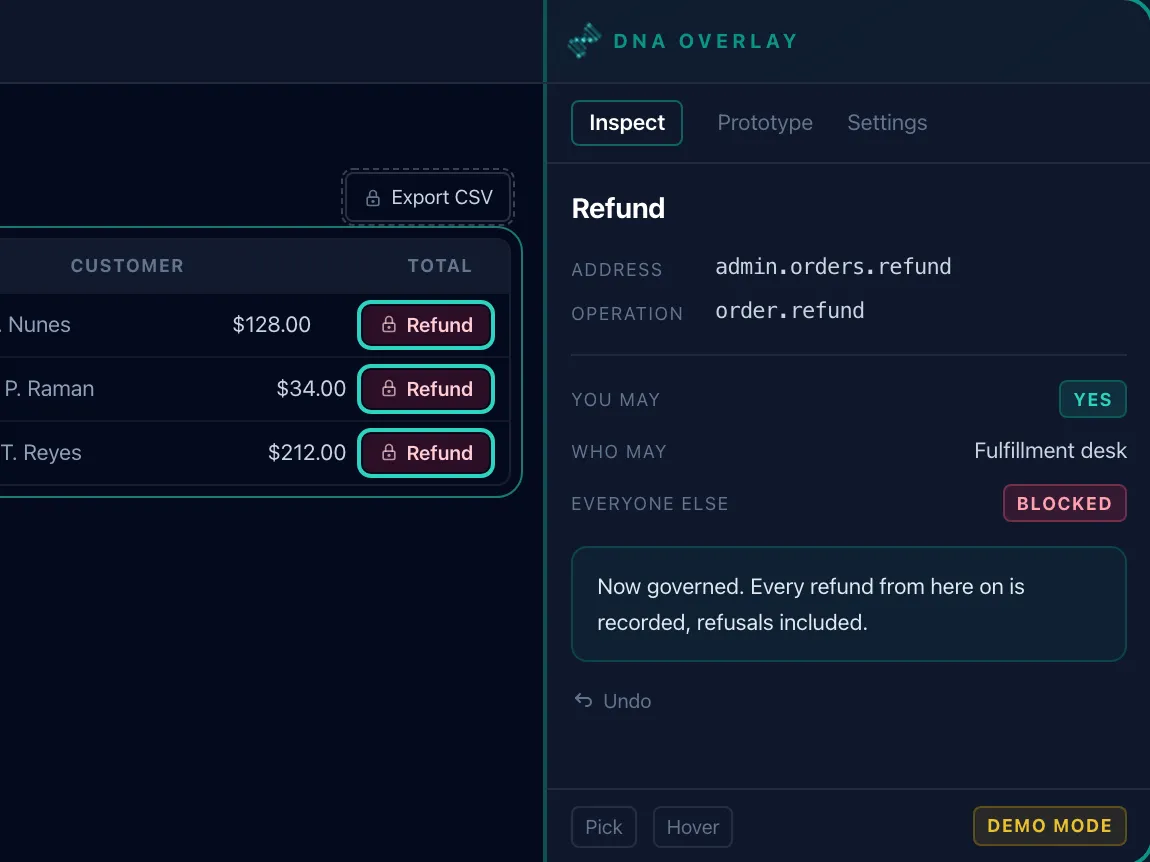
Describe your business once in DNA.
Operate it through various lenses.
Who reports to whom
End-to-end workflow from patient arrival through diagnosis and checkout.
Step by step — who does each part
Verify patient identity, confirm insurance, and collect co-pay at the front desk.
Record vitals, note chief complaint, and assess urgency before the physician encounter.
Conduct the clinical assessment, review history, and form a working diagnosis.
Collect payment, schedule follow-ups, and provide after-visit instructions.
Each role's responsibilities — derived from the DNA. Click to expand.
Practice Manager
Oversees daily clinic operations, staff scheduling, compliance, and billing performance.
Key Responsibilities
- Staff Scheduling
Set weekly shifts and ensure coverage for all clinic hours.
- Billing Oversight
Review claim submissions, denials, and collections to maintain revenue cycle health.
Physician
Diagnoses and treats patients, reviews medical histories, and prescribes treatments.
Key Responsibilities
- Examination
Conduct the clinical assessment, review history, and form a working diagnosis.
- Write Prescription
Issue prescriptions and log medication changes in the patient record.
Nurse
Triages patients, records vitals, and coordinates care between physician and front desk.
Key Responsibilities
- Triage
Record vitals, note chief complaint, and assess urgency before the physician encounter.
- Medical History Review
Pull and review prior records to inform the current encounter.
Front Desk Coordinator
Manages scheduling, check-in, insurance verification, and patient checkout.
Key Responsibilities
- Check In
Verify patient identity, confirm insurance, and collect co-pay at the front desk.
- Checkout
Collect payment, schedule follow-ups, and provide after-visit instructions.
- Schedule Appointments
Manage the appointment calendar and send confirmation reminders.
- Insurance Verification
Confirm active coverage and benefits prior to the visit.
Who reports to whom
Workflow from order placement through final delivery confirmation.
Step by step — who does each part
Ingest the order, validate line items, and confirm inventory availability.
Retrieve items from warehouse locations, verify quantities, and package for shipment.
Generate shipping labels, hand off to the carrier, and update order status with tracking.
Verify carrier confirmation, close the order, and trigger the post-purchase follow-up.
Each role's responsibilities — derived from the DNA. Click to expand.
Operations Director
Owns end-to-end fulfillment performance, carrier relationships, and SLA commitments.
Key Responsibilities
- SLA Monitoring
Track fulfillment cycle times against committed service levels and escalate exceptions.
Order Manager
Processes incoming orders, validates payments, and coordinates with the warehouse on priority queues.
Key Responsibilities
- Receive Order
Ingest the order, validate line items, and confirm inventory availability.
- Payment Verification
Confirm payment authorization and flag held or declined transactions for review.
Warehouse Lead
Directs pick-and-pack operations, manages inventory accuracy, and oversees outbound shipments.
Key Responsibilities
- Pick & Pack
Retrieve items from warehouse locations, verify quantities, and package for shipment.
- Ship
Generate shipping labels, hand off to the carrier, and update order status with tracking.
- Inventory Management
Maintain real-time stock counts, trigger replenishment, and audit cycle counts.
Customer Support Lead
Handles delivery inquiries, manages returns, and resolves post-shipment exceptions.
Key Responsibilities
- Confirm Delivery
Verify carrier confirmation, close the order, and trigger the post-purchase follow-up.
- Returns Processing
Receive returned items, inspect condition, issue refunds or exchanges, and restock.
Who reports to whom
End-to-end cycle from feature spec through production deployment.
Step by step — who does each part
Define requirements, break down tasks, and assign work for the sprint.
Implement the feature across backend and frontend layers with unit test coverage.
Review pull requests for correctness, style, and test coverage before merge.
Merge to main, run CI, cut a release, and promote to production with observability checks.
Each role's responsibilities — derived from the DNA. Click to expand.
Engineering Lead
Owns the delivery roadmap, sets technical direction, and coordinates cross-functional priorities.
Key Responsibilities
- Plan
Define requirements, break down tasks, and assign work for the sprint.
- Code Review
Review pull requests for correctness, style, and test coverage before merge.
- Deploy
Merge to main, run CI, cut a release, and promote to production with observability checks.
- Sprint Planning
Prioritize the backlog and commit team capacity for the upcoming sprint.
Backend Engineer
Builds and maintains server-side logic, APIs, and data models.
Key Responsibilities
- Build
Implement the feature across backend and frontend layers with unit test coverage.
- API Design
Define contracts, schemas, and versioning strategy for new endpoints.
Frontend Engineer
Implements user interfaces, handles client-state, and ensures cross-browser compatibility.
Key Responsibilities
- UI Development
Translate designs into responsive components and wire up API integrations.
QA Engineer
Designs test plans, runs regression suites, and tracks defects to closure.
Key Responsibilities
- Test Planning
Write test cases covering happy paths, edge cases, and regression scenarios.
- Bug Reporting
Document defects with reproduction steps, severity, and affected builds.
Who reports to whom
End-to-end origination workflow from borrower application to fund disbursement.
Step by step — who does each part
Collect and verify borrower information, open a loan file, and confirm application completeness.
Review the borrower's credit profile, debt-to-income ratio, and collateral against current lending policy.
Prepare and execute closing documents, confirm borrower signatures, and satisfy outstanding conditions.
Release approved funds to the borrower's designated account and update loan status to active.
Each role's responsibilities — derived from the DNA. Click to expand.
Lending Manager
Owns the lending process end to end, setting credit policy and resolving escalations across the team.
Key Responsibilities
- Exception Review
Adjudicate loan applications that fall outside standard credit policy parameters, documenting rationale.
- Pipeline Management
Monitor active loan pipeline for SLA adherence, identify bottlenecks, and report on team throughput.
- Compliance Sign-off
Verify that each approved loan meets applicable regulatory and audit requirements before closing.
Loan Officer
Works directly with borrowers from initial application through to final funding, serving as the primary point of contact.
Key Responsibilities
- Intake Application
Collect and verify borrower information, open a loan file, and confirm application completeness.
- Collect Documents
Gather income verification, tax returns, and borrower ID to complete the application file.
- Applicant Communication
Keep borrowers informed of status, outstanding conditions, and next steps throughout the process.
Underwriter
Assesses credit risk and borrower eligibility, issuing approval recommendations based on policy and financials.
Key Responsibilities
- Run Credit Check
Pull the borrower's credit report and score to establish a baseline for the underwriting review.
- Underwrite Loan
Review the borrower's credit profile, debt-to-income ratio, and collateral against current lending policy.
- Risk Assessment
Evaluate collateral value, loan-to-value ratio, and market risk to complete the credit recommendation.
Closing Specialist
Executes closing documentation and disburses approved funds, ensuring regulatory compliance at every step.
Key Responsibilities
- Prepare Closing Documents
Assemble and review all required closing documents, ensuring accuracy before the signing appointment.
- Close Loan
Prepare and execute closing documents, confirm borrower signatures, and satisfy outstanding conditions.
- Disburse Funds
Release approved funds to the borrower's designated account and update loan status to active.
Operations Layer
Structure how your business runs — from meeting notes and process docs to executable flows your whole team can follow.
Collect
Pull in your existing docs, SOPs, and tribal knowledge from anywhere.
Structure
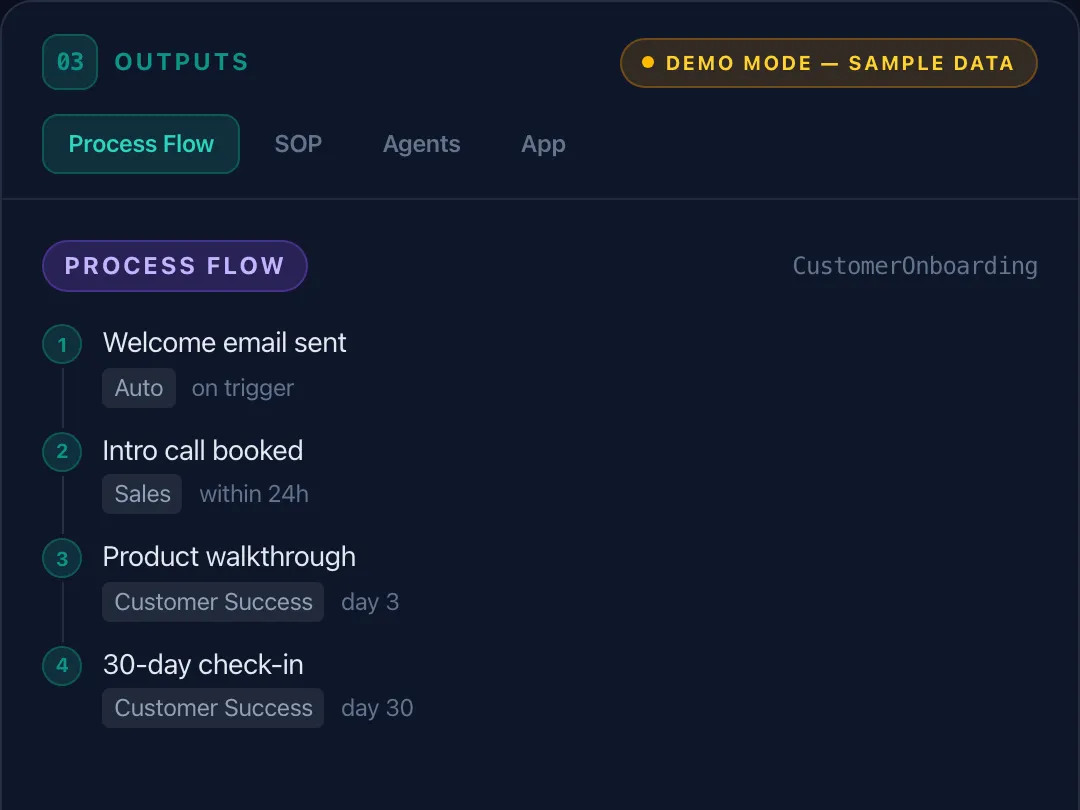
DNA Codes reads your content and writes a living spec — versioned, owned, always current.
Generate
Produce any artifact on demand — SOP docs, process flow diagrams, runbooks, and more.
Welcome email sent
Account setup call
Intro walkthrough
30-day check-in
| Process | Ops | Sales | Customer Success | Finance |
|---|---|---|---|---|
| Onboarding | A | C | R | I |
| Lead handoff | I | R | A | I |
| Monthly close | A | I | I | R |
| Vendor review | R | C | I | A |
Distribute
Push changes to every tool your team already uses — automatically kept in sync.
Bring order
to your ops.
Encode your processes. Give your team a single source of truth.